Hiring teams sort through hundreds of résumés a week, looking for keywords that may or may not reflect what a candidate can actually do. Candidates spend hours tailoring CVs to algorithms they can't see. The mismatch costs both sides time and quality.
Background
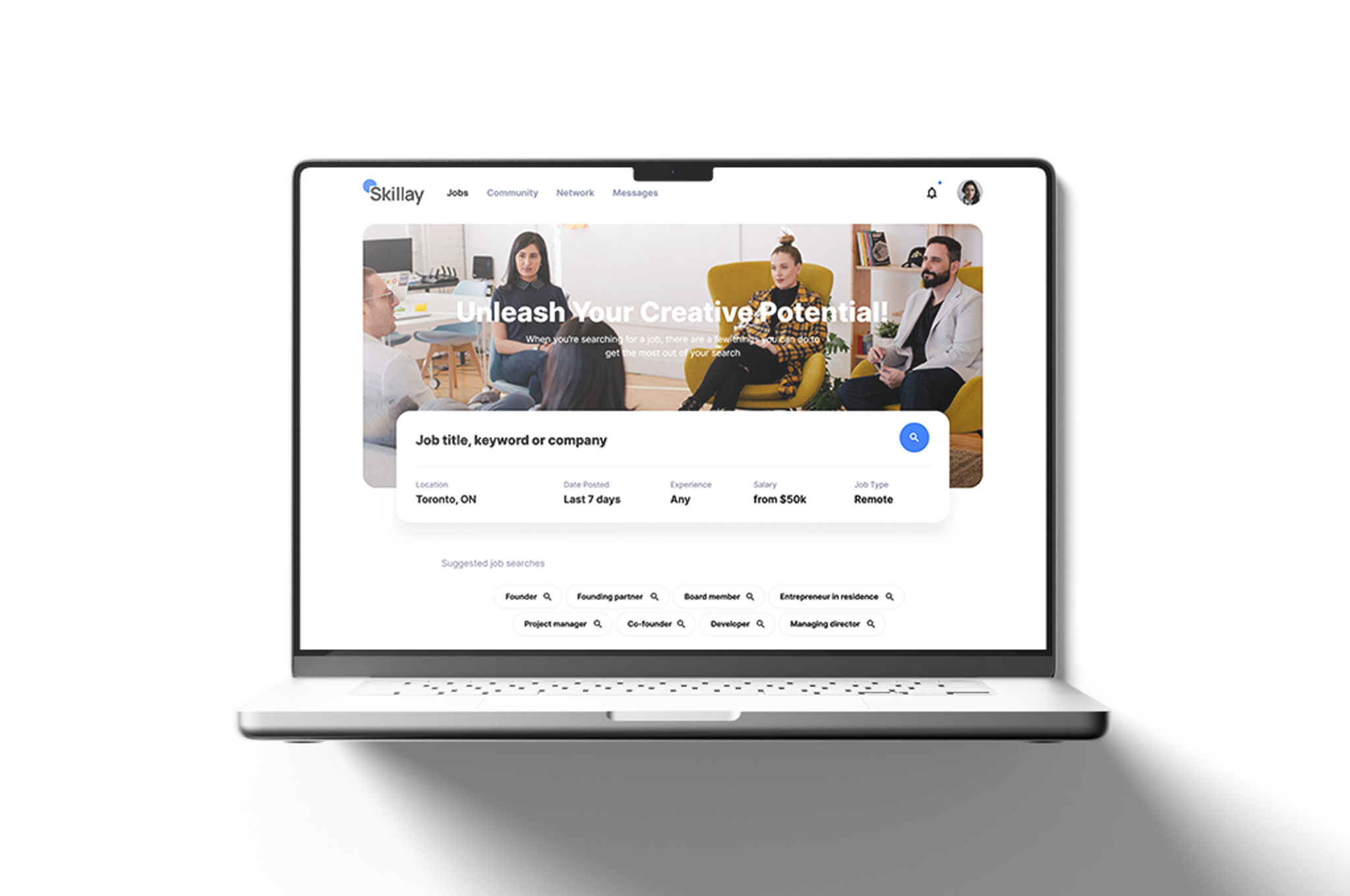
Skillay is an employment platform emphasizing skill demonstration over traditional credentials. The system combines skill challenges, assessments, and AI analysis to help employers understand candidate capabilities while enabling job seekers to display their genuine potential.
Problem — 78% of job seekers felt their resumes failed to accurately reflect their skills. 84% of employers reported difficulty evaluating candidates solely through resumes.
Solution — Skill-based assessments mirroring real job scenarios. AI generates personalized feedback and analytics, creating detailed profiles that reveal strengths and organizational fit.
Result — Simplifying the challenge submission process and providing real-time feedback increased user engagement by 35% during testing.
UX Approach
We ran 12 stakeholder interviews across both sides of the market — job seekers and hiring managers. The research confirmed a universal frustration: credentials don't predict performance.
Key insight — Both sides wanted a faster, fairer signal. Job seekers wanted to demonstrate real ability. Employers wanted to see work, not descriptions of work.
Design principle — Every design decision was tested against one question: does this make the match more accurate or the process more fair?
Process
Heading
Context
A broken status quo
A broken status quo

Image caption

Paragraph
Hiring teams sort through hundreds of résumés a week, looking for keywords that may or may not reflect what a candidate can actually do. Candidates spend hours tailoring CVs to algorithms they can't see. The mismatch costs both sides time and quality.
Image caption
Stats
12
stakeholder interviews
87
survey respondents
8
weeks end-to-end
Image caption
Pull Quote
I list ten skills on my résumé. They don't ask about any of them in the interview.
Candidate, interview #4
Image caption
Image Gallery
Image caption
Two-Column Comparison
Image caption
What we tried
A gamified test where users earned skill badges through 15-minute challenges. Drop-off was 62%.
What worked
Short, contextual micro-tasks tied to actual job requirements. Average completion: 4 minutes.
Inline Video
Image caption
Annotated Image

Image caption
[{"x":18,"y":22,"label":"Visible AI confidence score, not hidden behind a black box"},{"x":78,"y":45,"label":"Skill evidence preview before applying"},{"x":38,"y":82,"label":"Real micro-task, not a generic personality quiz"}]
Side-by-Side Static
Image caption
Before — traditional matching

After — Skillay matching

Table
Image caption
Approach comparison
{"headers":["Approach","Time","Drop-off","Signal"],"rows":[["Résumé keywords","~2s scan","N/A","Low"],["Gamified test","15 min","62%","Mid"],["Micro-tasks","4 min","18%","High"]]}
Embed
Image caption
Heading
Outcome
Where it landed
Where it landed
Image caption
Stats
5/6
users completed core flow without help
4 min
avg. time to complete a skill task
8/10
said they'd use it over LinkedIn
Image caption
Heading
Reflection
What I'd do differently
What I'd do differently
Image caption
Callout
We designed the candidate side beautifully but never validated the matching algorithm with employers. Next time I'd run a parallel employer-side discovery from week one — the prettiest candidate experience doesn't matter if the buyer side never gets used.
We designed the candidate side beautifully but never validated the matching algorithm with employers. Next time I'd run a parallel employer-side discovery from week one — the prettiest candidate experience doesn't matter if the buyer side never gets used.
Image caption
Design Impact
Skillay's core loop — browse role, complete micro-task, see match score — tested significantly better than both keyword scanning and gamified assessments.
5/6 users completed the core candidate flow without guidance
4 minutes average task completion time vs 15-minute gamified alternative
8/10 participants said they'd choose Skillay over LinkedIn for job discovery
Takeaways
Skill-based hiring is possible but requires designing for two audiences simultaneously. The candidate experience is only valuable if employers trust the signal — and trust requires transparency in how skills are assessed.
Shorter micro-tasks consistently outperformed longer assessments on both completion rates and self-reported fairness.
Reflection
We designed the candidate side beautifully but never validated the matching algorithm with employers. Next time I'd run a parallel employer-side discovery from week one — the prettiest candidate experience doesn't matter if the buyer side never gets used.